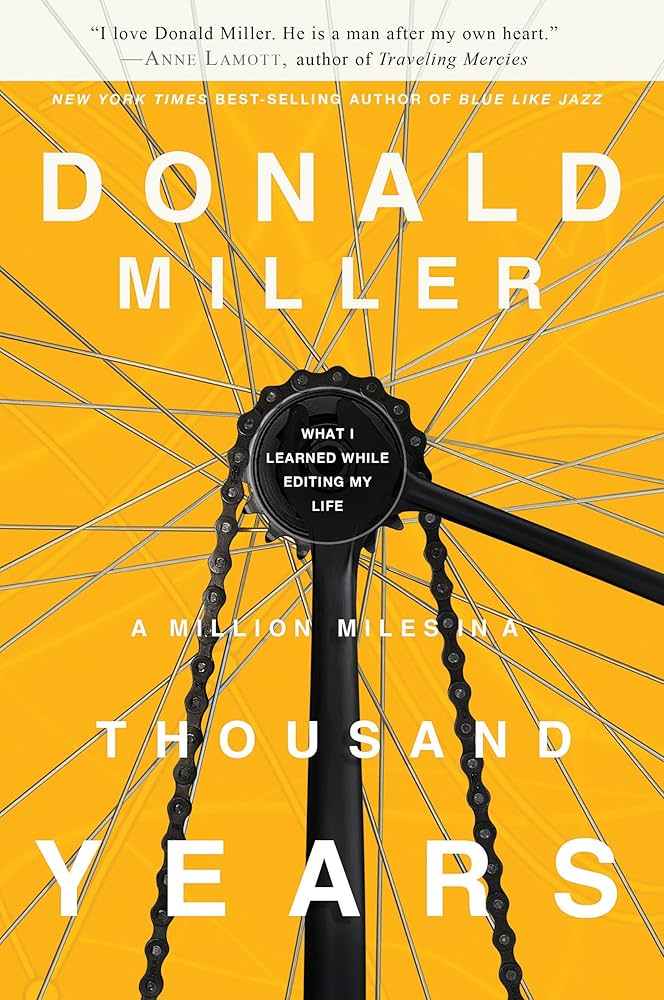
Summary
— Part One: Exposition —
“The saddest thing about life is you don’t remember half of it.”
Chapter 1: Random Scenes
When Your Own Life Feels Like Someone Else’s Slideshow
Donald Miller opens the book by doing something unexpectedly brave: he tries to remember his life. Not the highlights – the actual texture of it. And what he finds is mostly nothing. A merit badge from Cub Scouts. A flag football touchdown. A few storms. The homecoming queen asking for a kiss. Random scenes strung together with no obvious thread.
He thinks about his friend Bob, who has written over five hundred pages of his own memories – not because the memories were extraordinary, but because Bob understood that if you don’t capture a moment, it disappears. It’s as if it never happened. It’s as if you never lived it.
This is Miller’s first provocation: most of us are living lives we are not paying attention to. We’re watching the film of our lives from ten rows back with a bag of popcorn, waiting for something interesting to happen. The things we remember – wins, losses, embarrassments, moments of unexpected beauty – feel like they ought to add up to something. But do they?
Key Insight: We don’t just passively experience life. We narrativize it – or fail to. And the stories we are living (or neglecting to live) determine whether our existence feels meaningful or hollow.
But what does it actually mean to live a story? And what happens when someone offers to put your real life on a movie screen?
Chapter 2: A Million Miles in a Thousand Years
When Two Filmmakers Arrive and Ruin Your Comfortable Life
The inciting incident of the whole book arrives with a phone call. Two filmmakers – director Steve Taylor and cinematographer Ben Pearson – want to turn Miller’s bestselling memoir Blue Like Jazz into a movie. They fly to Portland. It is snowing. They drag a kayak through the streets behind a pickup truck. And somewhere in the middle of this absurd afternoon, Steve says something that changes everything:
To make a movie, they need a story. Not just scenes – a story. A character with a clear desire who faces real obstacles and is transformed by overcoming them. And Don’s actual life? Steve says, with gentle but devastating honesty, that it would make audiences want to stab each other with drinking straws. Nothing against the book. It’s a fine book. But a book can live inside your head. A movie can’t.
This is where Miller first encounters the concept that will drive the entire book: the structural elements of a good story are not just for fiction. They are the architecture of a meaningful life. The question stops being ‘how do we make a good movie?’ and starts being ‘how do I make a life worth watching?’
Key Insight: A story requires a character who wants something, faces conflict in pursuit of it, and is changed by the journey. Miller realizes – with creeping horror – that his life has almost none of these elements.
But wait – if Miller’s real life is boring, who decides what the movie version should look like? And what happens when you start comparing your actual self to your fictional ideal?
Chapter 3: They Fell Like Feathers
The Dangerous Gift of Paying Attention
Before the serious story work begins, Miller gives us a scene of pure delight. Ben, the cinematographer, watches snow fall in Portland with the same reverence a child reads a favorite story. He watches each snowflake like it is the only one. He convinces the group to tie a kayak to the back of a truck and drag it through the streets. Miller crashes into a birdbath. Jordan runs into a tree. It is gloriously, pointlessly fun.
But the scene does something important. Ben’s attention – his willingness to be completely present to the extraordinariness of frozen water falling from the sky – gives everyone around him permission to notice, too. And noticing is where story begins. You cannot live a good story if you are sleepwalking through your days.
This is Miller’s first lesson from the filmmaking process: before you can edit your life, you have to actually see it. You have to stop treating ordinary moments as obstacles between you and wherever you’re going and start treating them as the point.
Lovely in theory. But what happens when you actually look at your real life and realize it is, in Steve’s words, genuinely boring?
Chapter 4: Your Real Life Is Boring
The Uncomfortable Truth About Comfortable Living
Steve Taylor delivers the verdict that no one wants to hear: Miller’s real life – the sleeping in, the pipe smoking, the movie-going, the contentment – would make a terrible film. Not because it is immoral or sad, but because nothing is happening. There is no want. No drive. No obstacle. No transformation. Just a pleasant man living pleasantly.
Miller wrestles with this. Is there something wrong with contentment? Why should life have to look like a story? He tries to argue the merits of the quiet life. But the filmmakers push back: the audience’s reaction to a story is not arbitrary. It reflects something deep in human nature. We are wired to care about characters who are going somewhere, who want something, who are willing to bleed for it.
The question becomes personal and spiritual: if God is the author of our lives, what kind of story does a comfortable, risk-free life tell about Him? What does it say about us?
Key Insight: A life without meaningful ambition is not the same as a life at peace. Comfort and meaning are not synonyms. Miller begins to understand that his contentment has actually been a form of hiding.
So Miller agrees to let the filmmakers shape a better story. But to create a fictional better version of himself, he first has to ask: who is Don Miller, really? And who does he want to become?
Chapter 5: Flesh and Soul Better
The Strange Mirror of Seeing Yourself Fictionalized
As the script takes shape, Miller encounters one of the most disorienting experiences a person can have: watching someone create a better, fictional version of you. The movie Don is more decisive, more adventurous, more willing to take risks than the real Don. He’s a character who does things. And the real Miller has to sit with the uncomfortable question: why can’t I be more like him?
This is where the book makes its first deep turn. Miller begins to understand that the fictional self is not a fantasy – it’s a diagnostic. The gap between who you are and who your best story would require you to be reveals exactly where you have been avoiding growth. The movie version of you is a mirror, not a fantasy.
He starts to ask: what if instead of just making the movie, I actually became the character the movie needs?
Before Miller can fully commit to this idea, life interrupts with grief – and grief turns out to be one of the most powerful story teachers of all.
Chapter 6: My Uncle’s Funeral and a Wedding
What Endings Teach Us About the Middle
Miller attends two events in close succession – a funeral and a wedding – and is struck by the difference between them. At the funeral, people speak about a life in the past tense. They describe what a person meant, what they did, what they loved. At the wedding, the couple stands at the threshold of a story that is just beginning, full of potential and unknowing.
The funeral forces Miller to confront what he does not want to confront: when his life is over, what will be said? What story will be told? Not what accomplishments will be listed, but what kind of character was lived. Was there sacrifice? Was there love that cost something? Was there a journey?
The juxtaposition is not morbid – it is clarifying. Weddings are beginnings. Funerals are endings. And what determines whether an ending is meaningful is what happened in the middle – whether the character wanted something, pursued it, and was changed by the effort.
Key Insight: Most of us spend our lives trying to avoid the hard parts of the story. But Miller learns that it is precisely the hard parts – the grief, the loss, the failure – that give a story its weight and its beauty.
But how does a person actually start writing a better story for their life? Miller goes to find someone who might know.
Chapter 7: Going to See the Guru
Robert McKee and the Surprising Grammar of a Good Life
Miller attends a seminar by legendary screenwriting teacher Robert McKee – the man who wrote Story, the bible of narrative structure. McKee is brilliant, profane, and completely uninterested in sentiment. He teaches story not as a feel-good art form but as a ruthless discipline: the universe of a story has rules, and violating them produces confusion, boredom, and meaninglessness.
The core of McKee’s teaching, as Miller receives it, is this: a story is not a collection of nice moments. It is a structure. It has a protagonist who wants something deeply, who faces increasingly difficult obstacles, who is forced to become someone new in order to overcome them, and who finally achieves or fails to achieve the desire – and is transformed either way.
Miller sits in the seminar and realizes he is not thinking about movies. He is thinking about his life. Every principle McKee articulates about why stories fail applies to the way most people live: no clear want, no willingness to face obstacles, no transformation. A life without story structure is not peace – it’s stagnation dressed up as contentment.
Once Miller has the grammar of story, he can finally articulate what a meaningful life actually requires. And the answer is both simpler and harder than he expected.
Chapter 8: The Elements of a Meaningful Life
The Formula No One Teaches You in School
Drawing on McKee’s framework and his own deepening reflection, Miller distills what a meaningful life requires into the same elements a good story requires. A character must want something. The desire must be worth having – it must cost something, require risk, demand growth. The character must face genuine obstacles, not just inconveniences. And the journey must change them.
Miller is careful here: he is not saying life should be dramatic in a Hollywood sense. He is saying that the quiet, invisible choices we make about whether to pursue something that matters – whether to take a risk for love, for community, for faith, for a cause – are what separate a meaningful life from a pleasant one.
He notes that many people live in what he calls ‘a false story’ – a narrative they’ve told themselves about why they can’t do the thing they actually want to do. And as long as they stay inside that story, they never have to face the fear of trying and failing. But they also never feel fully alive.
Key Insight: The elements of a meaningful story – want, obstacle, transformation – are also the elements of a meaningful life. You cannot have one without the others. Transformation does not happen in comfort. It happens in pursuit.
But what does this actually look like in the real world? Miller is about to witness a father who puts these principles into practice in the most unlikely way – and it will stop him cold.
Chapter 9: How Jason Saved His Family
The Most Important Story in the Book
This chapter is the emotional heart of Part One, and arguably of the entire book. Miller tells the story of a friend named Jason whose teenage daughter had begun dating a drug dealer and seemed to be spiraling into self-destruction. Jason had tried everything – talking, grounding, confiscating her phone. Nothing worked.
Then Jason did something no parenting book would have suggested. He decided to create a new story for his family. He sold his boat. He took the money and began building an orphanage in Mexico – taking his whole family on work trips, involving his daughter in the mission. Not as a strategy. As a story.
Something shifted. The daughter began to pull away from the drug dealer. Her identity changed as the family’s story changed. She was no longer a girl without purpose in a comfortable suburban home – she was a girl whose family built orphanages. She had a story worth being part of. And that story turned out to be more compelling than the false one the drug dealer was offering.
Miller is wrecked by this. Not because the solution was clever, but because it reveals something profound: we are all living inside a story, and we will find a story to belong to – even if it’s a destructive one. The question is whether the people who love us are offering a better story.
Key Insight: People need a story to belong to. If you don’t give the people in your life a story worth being part of, they will find one elsewhere. Leadership, parenting, friendship – they are all acts of storytelling.
Part One has laid the foundation. Now the question becomes: what does it mean to actually become a character? Not to talk about it, not to plan it – but to do it?
— Part Two: A Character —
“A character is what he does – not what he thinks, not what he plans, not what he feels.”
Chapter 10: Writing the World
The Author’s Power – and Yours
Miller shifts perspective here. He begins thinking not just as a character in a story, but as an author. What does an author do? An author creates a world and fills it with people who want things. An author is responsible for what happens – for the choices made, the scenes written, the direction taken.
He makes a connection that sounds simple but cuts deep: in your own life, you are both a character and an author. You are living in a story, yes – but you also have the power to write the next scene. The question is whether you are exercising that authorial power or whether you have surrendered it – to comfort, to habit, to what other people expect.
Miller introduces the idea that God, in some sense, is the ultimate Author – but that He invites us into the act of co-creation. Our lives are not predetermined scripts. They are collaborative works. And the quality of what gets written depends on whether we show up willing to write something worth reading.
But here’s the problem with trying to write a perfect story: you will mess it up. Repeatedly. Does that mean the story is ruined?
Chapter 11: Imperfect Is Perfect
Why Flawed Characters Are the Only Kind Worth Reading
Miller confronts one of the great lies that keeps people from living better stories: the belief that you need to have it together before you can start. That you need to be healed, ready, competent, and confident before you can pursue something meaningful.
But great stories are not built on perfect characters. They are built on honest ones. The characters we love most are the ones with obvious flaws who pursue something anyway – whose imperfection is visible, sometimes embarrassing, often costly – and who keep going regardless. Their flaws are not obstacles to the story. They are the story.
Miller takes this personally. He has spent years waiting to be a different person before living differently. The filmmakers’ process has revealed something important: you don’t write the character you wish you were and then try to become him. You write the character you actually are – limitations and all – and you put him in motion.
Key Insight: You don’t need to be fixed to start. You need to start in order to be fixed. The movement itself is what changes you – not preparation for movement.
But there’s a catch. If you start moving – if you actually step into a meaningful story – you will not be the same person when you come out the other side. Are you ready for that?
Chapter 12: You’ll Be Different at the End
The Terrifying Promise of Transformation
Miller examines why transformation is so frightening. Not failure – transformation. Because the person who completes a meaningful journey is not the same person who started it. Old comforts no longer comfort. Old stories no longer fit. Old relationships sometimes can’t survive the change. And there is no way to know, at the beginning, exactly who you will become.
He explores this through the lens of the movie-making process: every good screenplay has a character arc. The protagonist at the end of Act Three is not the same as the protagonist in Act One. Something essential has shifted – a belief has been surrendered, a fear has been faced, a capacity for love or courage or sacrifice has been discovered.
The invitation of a meaningful story is also a warning: if you say yes, you will lose something. Usually something you are currently holding onto very tightly.
So if transformation is the goal – if becoming someone different is the prize – then what does it actually mean to be a character? What does character consist of?
Chapter 13: A Character Is What He Does
The Brutal Simplicity of Action
This chapter contains one of the most important sentences in the book: a character is not what he thinks or feels or plans – a character is what he does. Full stop.
Miller applies this to himself with uncomfortable honesty. He is a person who thinks many meaningful thoughts. He writes about deep things. He talks about living better. But for most of his adult life, the actions have not matched the internal narrative. He has been a character in his own head, living a very different story in his actual body.
The filmmakers can only work with what’s on the screen. They can’t show the audience Miller’s interior life. They can only show what he does – and what he does in the early pages of his real life is not particularly interesting. This forces a reckoning: if someone were watching the footage of my days, what would they see?
Key Insight: Character is not intention. It is action. You are not the person you intend to be – you are the person you have been, in your choices, in your days, in what you actually did with your time and your money and your energy.
But here’s where it gets interesting: Miller discovers a screenwriting concept that unlocks something profound about how character is built – one small, seemingly insignificant act at a time.
Chapter 14: Saving the Cat
How Small Acts Reveal Who You Really Are
Miller introduces the screenwriting concept of ‘saving the cat’ – a technique where the writer shows the protagonist doing something small but revealing early in the story, something that makes the audience like and trust them before anything dramatic has happened. Saving a cat from a tree. Helping a stranger. Standing up for someone.
The insight is not about performing goodness for an audience. It is about the fact that character is revealed in small moments – not in the moments of crisis we imagine will define us, but in the daily unremarkable choices that no one is watching and that we barely notice ourselves.
Miller begins to ask himself: what are my daily unremarkable choices saying about my character? What cat am I saving – or failing to save? What kind of person am I when nothing important is at stake?
This chapter reframes the entire project of living better. It is not about grand gestures or dramatic decisions. It is about the texture of ordinary days – and whether those days reflect the person you claim to be.
There is a voice that speaks to the writer, telling the story where it needs to go. And Miller begins to wonder: is there a voice speaking to each of us – about our lives?
Chapter 15: Listen to Your Writer
The Quiet Voice That Knows Where You’re Supposed to Go
Every good writer knows the experience: you’re working on a story, and suddenly the characters start to feel real. They start to resist the plot you’ve planned for them. They start to feel like they have their own agency, their own needs, their own direction. And the best writers learn to listen to this – to follow the story where it wants to go rather than forcing it where you planned.
Miller uses this as an analogy for spiritual life. There is a sense in which we are characters in a story being written by someone else – by God, or by life itself – and part of our task is to listen. To pay attention to the invitations embedded in our circumstances, our longings, our encounters. Not to live by committee or by fear, but to hear what the story is asking of us.
He is careful not to make this mystical in a vague way. The ‘voice’ is often just the deep pattern of your longings – what you have always wanted but been afraid to pursue. And listening to it means taking seriously the desires you have been dismissing.
Key Insight: Your deepest longings are not random noise. They may be the clearest signal you have about the story you are supposed to be living. Dismissing them as impractical or immature is one way to avoid the terrifying prospect of actually pursuing them.
But there’s a moment where thinking about the story has to stop – and something has to actually go on the page. Or in life: something has to actually happen.
Chapter 16: Something on the Page
The Only Way to Write a Story Is to Write It
Miller returns to the basic truth that haunts every writer and every person: the story doesn’t exist until you start. Not when you have the perfect plan. Not when you feel ready. Not when the conditions are right. It exists when you begin – imperfectly, nervously, with no guarantee of outcome.
He describes the paralysis he feels in front of a blank page, and the way that paralysis perfectly mirrors the paralysis he feels in front of his own unlived life. The fear of beginning is the fear of committing to a direction, of foreclosing other options, of being seen trying and possibly failing.
But Miller makes the argument – drawn from storytelling and from his own slow conversion – that the beginning doesn’t have to be good. It just has to exist. Something on the page is infinitely better than the perfect story you are still planning in your head.
Part Two has established what a character is. Now Part Three confronts the hardest question: what does your character actually want? And are you willing to go after it?
— Part Three: A Character Who Wants Something —
“The human race was made to want things. Not to have them – to want them.”
Chapter 17: How to Make Yourself Write a Better Story
The Uncomfortable Decision That Changes Everything
Miller reaches the practical heart of the book’s first half: if you want to live a better story, you have to do the thing that every writer knows and fears. You have to decide to write it. Not plan to decide. Not wait for inspiration. Not outline until you feel certain. You have to choose, specifically and concretely, to pursue something that matters.
He begins doing this in his own life. The movie project becomes more than just a film – it becomes a laboratory for personal transformation. He starts saying yes to things his old self would have declined. He starts making choices the movie version of himself would make. And he begins to notice, gradually, that this is changing him.
The chapter is an honest account of what it feels like to choose to live differently. It is not dramatic. It does not feel meaningful in the moment. It feels uncomfortable and uncertain and a little embarrassing. But it is happening. Something is on the page.
But for a story to truly begin – for real change to occur – something has to happen that breaks the status quo. Miller is about to learn about the power of the inciting incident.
Chapter 18: An Inciting Incident
The Moment That Breaks Your Comfortable World Open
Every story has an inciting incident – the event that disrupts the protagonist’s normal world and forces them into the story. It might be a death, a diagnosis, a phone call, a discovery. It’s the moment when the old life becomes impossible and the new life – uncertain, frightening, full of potential – becomes necessary.
Miller explores this in terms of his own life and others’. He notices that the people who live the most meaningful lives often had an inciting incident – something that shattered a comfortable illusion and forced them into a truer, harder, better story. And he also notices that some people, when the incident arrives, refuse it. They try to put the world back the way it was. They resist the invitation.
He asks a painful question: what if you are waiting for your inciting incident when it already happened years ago – and you declined it?
Key Insight: Inciting incidents are often unwelcome. They arrive as loss, as disruption, as the thing you didn’t want. But they are also invitations. The question is whether you step through the door they open.
Once a story is in motion, it needs a direction. The character needs to know where they’re going – even if they can’t see all the way there.
Chapter 19: Pointing Toward the Horizon
Why Your Story Needs a Destination, Even a Distant One
Miller makes a practical observation about stories and lives: a character needs a direction. Not a guaranteed destination – not certainty – but an orientation. A horizon to move toward. Without a horizon, every day looks the same as every other day, and there is no sense of progress, no accumulating meaning.
He applies this to his own life and begins setting horizons – specific things he wants to do, places he wants to go, experiences he wants to have that will require him to grow. Not a bucket list. A story list. Things that, if pursued, will demand that he become someone different.
The horizon doesn’t have to be heroic. It just has to be real, and it has to be yours – not what other people want for you, not what is expected, not what is safe. A horizon you actually want to move toward.
But what happens when the story takes a turn for the worse? What happens when life doesn’t cooperate with your new narrative?
Chapter 20: A Negative Turns
When the Story Goes Wrong – and Why That’s Actually Good
Miller introduces the structural concept of the ‘negative turn’ – the moment in a story when things get worse. The protagonist takes a step forward and gets knocked three steps back. The plan fails. The relationship fractures. The diagnosis arrives. The money runs out.
In storytelling terms, negative turns are not failures of the story – they are the engine of the story. Without them, there is no drama, no growth, no transformation. A character who encounters no resistance becomes no one in particular. It is exactly the resistance that carves them into the person the story needs them to be.
Miller applies this to his own life’s disappointments and losses. The things he has been grieving as deviations from the good story he wanted to live may actually be the things that make his story worth reading.
Key Insight: The bad things that happen to you are not evidence that your story is broken. They may be the most important scenes your story contains. The question is not ‘why did this happen?’ but ‘what will I do with it?’
But sometimes the story doesn’t just take a negative turn – sometimes it gets hijacked entirely. Miller is about to tell one of the most honest stories in the book.
Chapter 21: A Good Story, Hijacked
The Subtle Ways We Sabotage Our Own Narrative
This is one of the book’s most confessional chapters. Miller examines the ways people – including himself – start living a meaningful story and then quietly, subtly abandon it. Not dramatically. Not with a single bad decision. But through a slow accumulation of small retreats, compromises, and comfortable shortcuts.
He tells the story of a relationship that began with the energy and vulnerability of a genuinely good story – two people pursuing each other honestly, facing their own fears – that gradually collapsed back into safety and distance. Neither of them made a single catastrophic choice. They just stopped choosing the story they had started.
This is the hijacking Miller fears most: not external catastrophe but internal erosion. The good story you began, abandoned not because life overwhelmed you, but because you got tired, or comfortable, or afraid.
What if the antidote to a hijacked story is something small – a practice, a beginning, an experiment with a lower story before committing to the bigger one?
Chapter 22: A Practice Story
How to Start When You’re Not Ready for the Real Thing
Miller introduces the concept of a practice story – a smaller, lower-stakes version of the meaningful story you are afraid to live. A way of building the muscles of intentional living before you need them for the big climb.
He begins doing this in his own life: committing to smaller challenges, shorter horizons, more modest risks, that require the same posture – the same willingness to be uncomfortable, to fail, to show up anyway – as the larger story he is working toward. And he finds that the practice changes him. Each small story builds capacity for the larger one.
He also observes this in others: the people who live the most extraordinary lives did not begin there. They began with ordinary courage – a smaller yes, a modest risk, a beginner’s attempt – that accumulated, over time, into something remarkable.
And then – finally – something turns. A positive turn. And Miller learns what it feels like when a story begins to move in the right direction.
Chapter 23: A Positive Turn
The Surprise of Progress You Didn’t Plan For
Miller experiences the joy – and the surprise – of a positive turn in his own story. Things he had committed to without certainty of outcome begin to bear fruit. Not everything. Not all at once. But enough to confirm that the direction was right, that the story was moving, that the character was becoming.
He is careful not to make this triumphant in a false way. A positive turn in a story is not the end. It is a beat – a moment of confirmed direction before the next obstacle. But it is also genuinely good. It is the feeling of being alive in the way you were made to be alive.
And it raises a question Miller sits with: why don’t people talk about this more honestly? About what it actually feels like to live a good story – not as an abstraction, but as a physical, day-to-day experience of aliveness?
All of this has been preparation for a journey that Miller is about to actually take – one that will require everything he has been learning.
Chapter 24: Meeting Bob
The Man Who Biked Across America – and What He Lost Along the Way
Miller meets a man named Bob who has done something extraordinary: he biked across America. Alone. Over thousands of miles, through mountains and desert and heartland, Bob pedaled. When Miller asks what drove him to do it, the answer is not what he expects.
Bob is not a superhero. He is not someone for whom the journey was easy or natural. He did it because he needed to – because his life had reached a point where continuing in the same direction felt like slow death, and something in him demanded a story worth living. He did not know if he could finish. He started anyway.
Miller is profoundly moved by Bob – not by the achievement but by the honesty underneath it. Bob did not bike across America to prove something. He did it because a meaningful life requires you to choose something hard, and this was his hard thing. And having done it, he understands something about himself and about life that cannot be explained to someone who hasn’t made a similar choice.
Key Insight: The things worth doing are hard. That is not a bug – it is the point. The difficulty is what gives the doing its meaning. Easy victories teach us nothing about who we are.
Part Three has established the desire. Part Four confronts what desire costs when it meets the real world: conflict, sacrifice, and everything you didn’t expect.
— Part Four: A Character Who Wants Something and Overcomes Conflict —
“If you want to have a story, something has to go wrong.”
Chapter 25: A Better Story, an Epic, an Absurd Idea
When the Only Logical Move Is the Terrifying One
Miller decides to bike the Oregon Trail – all 500 miles of it. Not because it is reasonable or convenient or well-timed. Because it is the kind of thing that would make a good story, and because he has been learning that good stories require exactly this: an absurd commitment to something that matters more than comfort.
The decision is not triumphant. It is terrifying. He is not in shape. He has no particular reason to believe he will succeed. But he has learned enough about stories to know that this is precisely the kind of thing the character he is trying to become would do – and that you become the character by doing the things the character does, not by planning to do them someday.
He prepares. He trains. He is afraid. He goes.
The journey on the trail quickly teaches him something about crossings that he could not have understood from a distance.
Chapter 26: The Thing about a Crossing
Why You Cannot Understand the River Until You’re in It
Midway through the journey, Miller reflects on the nature of crossings – the moments in life when you step from one bank to another with no guarantee of reaching the other side. A marriage. A career change. A leap of faith. A five-hundred-mile bike ride through mountain passes.
He notices that crossings look very different from the outside than from the inside. From the bank, a crossing looks like a decision. From the middle of the river, it looks like survival. The current is stronger than you expected. The other bank is further than it looked. And there is no going back – or there is going back, but at a cost that now feels higher than continuing forward.
He learns something important: you cannot fully understand what a crossing will require of you until you have committed to it. The knowledge comes through the crossing itself, not in advance. Which means the only way to know is to go.
Key Insight: You will not be the same person at the end of a true crossing as you were at the beginning. That is the whole point. And it is also why crossings are frightening, because you are agreeing to become someone you cannot yet see.
But crossings are not meant to be taken alone. And Miller discovers something about pain and community that reframes everything.
Chapter 27: The Pain Will Bind Us
Why Shared Suffering Creates What Nothing Else Can
On the trail, Miller bikes alongside others who have committed to the same absurd crossing. And he discovers something that surprised him: the shared pain creates a bond that shared comfort never could.
The people he barely knew at the beginning become, by the midpoint, people he would trust with his life, because they have suffered together, complained together, pushed each other forward, and faced the same relentless headwinds. Comfort creates pleasant relationships. Shared difficulty creates real ones.
He extends this observation beyond the trail. The friendships, marriages, and communities that last are almost never the ones built in easy times. They are built in the years when things were hard – when there was real sacrifice, real vulnerability, real need. The pain is not a regrettable side effect of community. In some cases, it is the foundation of it.
And yet Miller knows that no single crossing – no individual story – tells the whole truth. He’s about to encounter one of the book’s most beautiful ideas.
Chapter 28: A Tree in a Story About a Forest
Your Story Is Part of a Much Larger One
Miller encounters an image that reshapes how he sees his own life: a single tree in a forest. The tree has its own story – its rings of growth, its storms endured, its years of drought and abundance. But the tree is also inseparable from the forest. It cannot be understood alone.
He applies this to human lives. Your story – the one you are living, the one that feels so singular and urgent and all-consuming – is a thread in a much larger narrative. The people who came before you, whose sacrifice and courage made your world possible. The people around you, whose stories intersect and overlap with yours in ways you may never fully see. The people who will come after you, who will inherit what you build or fail to build.
This is not a diminishment. It is an expansion. Your story matters because it is part of a larger story that matters. And the choices you make in your story ripple outward in ways you cannot track and may never witness.
Key Insight: Living a good story is not primarily about your own flourishing. It is about what your story contributes to the larger story – the one that includes everyone around you and everyone who will come after.
But if the story is bigger than us, and if transformation is necessary but not guaranteed – why does God let the hard things continue? Miller is about to sit with a question he cannot fully answer.
Chapter 29: The Reason God Hasn’t Fixed You Yet
The Uncomfortable Theology of Unresolved Suffering
Miller turns to one of the most difficult questions in the book: why does God allow suffering to persist? Why, if He is good and powerful, does He not simply remove the thing that is causing pain?
Miller does not offer a simple answer – and this is one of the book’s most honest moments. He does not explain away suffering. He does not suggest that everything happens for a reason in a way that makes the pain bearable. Instead, he offers a storytelling perspective: the character who is protected from all difficulty is also the character who never grows, never changes, never becomes capable of the things the story requires.
This is not the same as saying suffering is good. It is saying that suffering can be meaningful – not because it is inherently redemptive, but because a story that includes honest pain, honestly faced, honestly survived, is a story that has weight and truth. And perhaps a God who is also a storyteller sees the deeper value of a life that has been forged rather than simply given.
Miller holds this lightly, with appropriate uncertainty. But it changes something in the way he relates to his own unresolved grief.
And as the book approaches its final chapters, Miller pulls back to look at the specific scenes that make up a life – and what makes one scene memorable and another forgettable.
Chapter 30: Great Stories Have Memorable Scenes
The Art of Living a Life Worth Remembering
Miller circles back to the book’s opening meditation – the sadness of not remembering your own life – and offers a counterproposal. What if you could live in such a way that the scenes are worth remembering? Not because they are dramatic, but because they are fully inhabited – moments of real presence, real love, real risk, real beauty?
He thinks about the scenes in his life that he does remember: the sunset at Smith Rock. The girl who didn’t wear shoes. The baby in his arms. The conversation with a friend that lasted until 3 a.m. Not his achievements. His encounters – the moments when he was fully present and fully alive.
A great story is not made of accomplishments. It is made of scenes. And a scene requires presence – the willingness to actually be there, to let what is happening matter, to stop narrating and start living.
Key Insight: The most memorable scenes in your life will probably not be the ones you planned. They will be the ones where you were fully present to something real. The discipline, then, is learning to show up fully – to let ordinary moments become scenes worth remembering.
And now – finally – Part Five. The character has wanted something, faced conflict, and survived it. What does it look like when you actually get there? And what do you do when the story ends?
— Part Five: A Character Who Wants Something, Overcomes Conflict to Get It —
“I don’t want to get to the end of my life and realize I’ve only lived a small story.”
Chapter 31: Squeezing the Cat
The Strange Grief of a Story That Is Almost Over
Miller finds himself near the end of the bike journey – and near the end of a season of life that has required tremendous growth – and he notices an unexpected emotion: grief. Not because anything has gone wrong, but because the end of a good story is always, in some way, a loss. The person you became in the story is real. But the story itself will end. And then you have to figure out what comes next.
He uses the image of squeezing a cat – the way children hold pets too tightly, not out of cruelty but out of love, because they know the pet will eventually walk away. We squeeze the things we love because we know they are temporary. And the best chapters of our lives are no different: we want to hold them past their natural ending.
But stories need endings. Not because endings are good, but because without endings there is no next beginning. The willingness to let a season close is what makes the next season possible.
And in that closing, Miller discovers something about tragedy that reshapes everything he thought he knew about beauty.
Chapter 32: The Beauty of a Tragedy
Why the Saddest Stories Are Sometimes the Most True
One of the most counterintuitive chapters in the book. Miller reflects on why tragic stories – stories of loss, of love that doesn’t survive, of dreams that don’t fully materialize – can be more beautiful than triumphant ones.
He does not argue that tragedy is better than joy. He argues that tragedy, when honestly depicted, contains a kind of truth that triumph sometimes cannot: the truth that things end, that love costs, that some things are simply lost and cannot be recovered. And there is something in the human heart that recognizes this truth and finds it more trustworthy than easy resolution.
He applies this to his own life’s grief – relationships that ended, seasons that closed, versions of himself he had to let go. These are not evidence that the story failed. They are the marks of a life that was actually lived, that risked something real, that loved something real enough to grieve its loss.
Key Insight: A life without any grief may not be a blessed life – it may be a life that played it too safe, that never loved anything enough to mourn it. The scars of genuine engagement are not shameful. They are the proof that you showed up.
But how do you keep showing up when the result is uncertain? How do you keep trying when trying is hard?
Chapter 33: All You Have to Do Is Try
The Radical Simplicity of the One Thing Required
Miller arrives at something approaching a thesis statement for the entire book – and it is simpler than he expected: all you have to do is try. Not succeed. Not guarantee the outcome. Not know in advance that it will work. Just try.
He has been building to this for thirty-three chapters. The character who wants something. The obstacles. The transformation. The scenes. The grief. The beauty. And underneath all of it, the single requirement: be someone who tries. Someone who shows up. Someone who says yes to the story even when the ending is uncertain.
He tells this not as a motivational slogan but as a hard-won personal conclusion. He has been, for most of his life, someone who did not try – who waited until conditions were better, who preferred the comfort of intention to the exposure of action. And the movie-making process, the bike trail, the practice stories, the grief – all of it has taught him that the trying is the thing. Not the outcome. The trying.
And there is one more thing that trying requires – one act that Miller has been circling all along and that he finally names in the book’s most quietly powerful chapter.
Chapter 34: To Speak Something into Nothing
The Creative Act of Choosing the Life You Want to Live
Miller returns to the image of God as author – and the invitation to participate in that authorship. He notes that the act of creation begins with speaking something into nothing: God speaks, and there is light. The writer types, and there is a character. The person decides, and there is a life.
The act of speaking your intention – of naming the story you want to live, the person you want to become, the things you want to pursue – is itself a creative act. Not magic. Not mere positive thinking. But the first essential move in the direction of a different life.
Miller has been doing this throughout the book: naming things. Naming the life he had been living as insufficient. Naming the kind of character he wanted to become. Naming the things he wanted to pursue. And in the naming, something began. Something real, something that had not existed before, came into being.
Key Insight: The stories you tell about yourself – to yourself, to others – are not merely descriptions. They are prescriptions. The words you choose to describe your life begin, over time, to create it. Speak the story you want to live, and then live toward it.
One last scene. One last winter image. And then Miller lands on the simplest, most honest conclusion a book like this can reach.
Chapter 35: Summer Snow in Delaware
When the Unexpected Beautiful Arrives Without Warning
In one of the book’s final stories, Miller describes watching snow fall in Delaware in the middle of summer – a freak meteorological event that stops everyone in their tracks. People come outside. They look up. They let the snow fall on their faces. For a few minutes, everyone is present.
The snow does not last. It melts almost immediately. But the moment is real – and everyone who witnessed it carries it with them in a way that ordinary days do not leave traces. The unexpected beauty broke through the ordinary and made everyone feel, for a moment, that they were part of something larger than their individual lives.
Miller uses this as his penultimate image for what a well-lived life can offer: moments of unexpected beauty that break through the ordinary and remind you – and the people around you – that the world is more remarkable than it usually appears. And the people who create those moments, who live in such a way that others get to witness unexpected beauty, are telling a story that others want to be part of.
And finally – the last chapter. Not a conclusion, but a commitment.
Chapter 36: Telling a Story Demands Courage
The Last Thing You Need – and the First Thing to Begin
Miller ends with a direct and unadorned truth: living a better story requires courage. Not talent. Not special circumstances. Not the right timing or the perfect conditions. Just courage – the willingness to begin, to risk, to fail, to try again, and to keep choosing the story over the comfort of not choosing.
He does not end triumphantly. He ends honestly. He is still the same flawed, uncertain, sometimes-sleeping-in, sometimes-afraid person he was at the beginning. The filmmakers came and went. The movie got made. The bike trail was biked. The seasons changed. And he is different – genuinely, measurably different – but not because life became easy or certain or clear.
He is different because he said yes, more times than before, to the story. Because he allowed the process of storytelling – of crafting something with shape and meaning and direction – to reshape him. Because he stopped waiting to feel brave and started doing the thing that brave people do.
And he closes with an invitation, extended to the reader as gently and directly as he knows how: whatever your story is, whatever you have been waiting for – begin. The story does not start when conditions are right. It starts when you decide it will.
• • •
What This Book Is Really About
A Million Miles in a Thousand Years is, at its core, a book about the gap between the life we are living and the life we sense we were made for – and the surprising discovery that closing that gap is less about circumstances than about choices.
Donald Miller is not a life coach. He is not a self-help author. He is a man who was comfortable and dissatisfied and honest enough to admit it, and who then used the unlikely laboratory of turning his memoir into a movie to discover what it actually means to live a story worth telling.
The book’s genius is that it never preaches. It shows. Scene by scene, chapter by chapter, it places you inside the experience of a man waking up – slowly, stumblingly, with many moments of retreat and failure – to the possibility that his life could be different. That the same story principles that make a film worth watching are the principles that make a life worth living. That you are not a passive audience member in your own story. You are the writer, the director, and the lead actor. And the production is already underway.
The question is not whether you will have a story. You already have one. The question is whether it is the story you would choose – and if not, whether you have the courage to begin editing it today.
• • •
“I just hope I have something interesting to say.”
— Donald Miller, A Million Miles in a Thousand Years
About Author